
Yes, it gets hotter than grass — but the 200°F number you’ve heard isn’t measuring your backyard. Here’s what the published research actually says, and what changes it.
The short answer
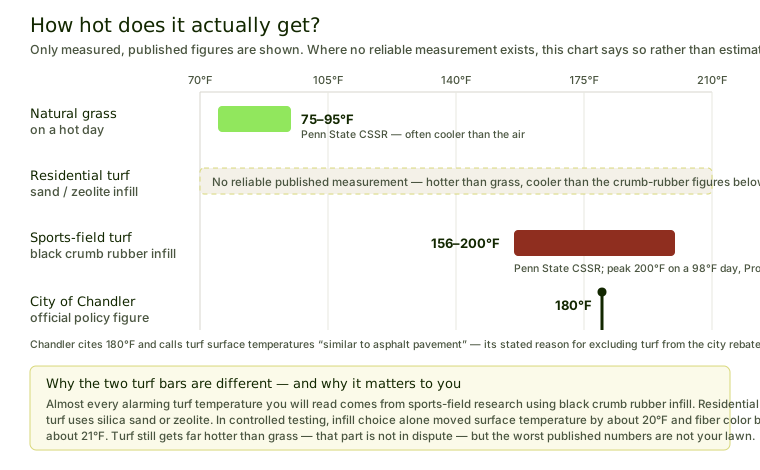
Yes — significantly. Published measurements put synthetic turf 35–55°F hotter than natural grass on a hot day. Natural grass typically sits at 75–95°F and is often cooler than the air around it, because living grass transpires — it releases moisture the way skin sweats. Turf has no such mechanism. It just absorbs heat and holds it.
That gap is real, and no amount of marketing changes it. But the number most people have heard — 200°F, measured on a sports field with black crumb rubber infill — isn’t the whole story, and getting that distinction right is the point of this page.
Where the scary numbers come from — and why they aren’t your backyard
The eye-popping figures come from a small set of studies, and they all measured the same kind of surface: athletic fields built with black crumb rubber infill.
- 200°F on sports-field turf with black crumb rubber infill, measured on a 98°F day in Provo, Utah (Williams & Pulley, 2002)
- 175°F, measured in central Pennsylvania (McNitt et al., 2008)
- 157°F, measured by BYU in June 2002 — on an 81°F day, with natural grass alongside it at 88.5°F
Every one of those is a sports field. Every one used black crumb rubber infill, which is about the worst-case material for heat absorption.
A residential lawn is usually a different system entirely — silica sand, coated sand, or zeolite infill instead of crumb rubber. And here’s the honest gap in the research: no comparable published measurement exists for residential turf. Rather than estimate one to fill the hole, this page says so plainly. Residential turf runs hotter than grass — that part isn’t in question — but the worst numbers in circulation describe a different product than the one going in most Phoenix backyards.
That’s not a reason to wave away the whole topic. It’s a reason to be specific about which product a given number is describing before deciding what it means for your yard. A page, a salesperson, or a neighbor citing “200 degrees” without saying whether that’s a football field or a residential lawn is skipping the part of the sentence that actually matters.
What Arizona cities say about it
The most credible figure in this whole conversation doesn’t come from a study or a turf vendor — it comes from a Valley city government, on the record, in an official policy document.
The City of Chandler, explaining why its water-conservation rebate excludes artificial turf, states that turf “can reach 180 degrees” and that its surface temperatures are “similar to asphalt pavement.” That’s Chandler’s own stated reasoning for turning turf away from a program that otherwise pays homeowners for water-saving landscaping.
Worth being precise about what that is: it’s a city making the case against turf as part of a rebate policy — a source with a position, not a neutral third party. But it’s still the single most credible number in this niche, because no turf vendor is going to volunteer it. If you’re also weighing whether turf qualifies for a water rebate in your city, see how each Valley city treats it.
What actually changes the temperature
Two things matter more than most people expect, and neither is “turf vs. grass” — they’re choices made within turf.
Infill moves the needle by roughly 20°F. In controlled testing, black rubber infill measured 156.0°F under identical conditions where TPE infill measured 136.4°F — a ~20-degree spread from infill choice alone. More on how infill types compare.
Fiber color moves it by roughly 21°F. Silver-toned fiber measured 149.4°F against white fiber at 128.7°F in the same testing. That’s a wider swing than most people assume color could account for, and it means fiber choice matters about as much as infill does — which cuts against the common assumption that crumb rubber alone explains the heat problem.
Shade is the biggest lever of all, though it comes with its own tradeoff. Chandler’s own guidance notes that turf installed too close to tree trunks and roots can damage the tree over time — so “just plant a tree next to it” isn’t free advice. The honest version: shade helps more than anything else on this list, and where you put it matters. A pergola, a shade sail, or an existing tree canopy positioned with enough clearance from the root zone will do more for a hot backyard than any infill or fiber-color choice on this page.
Put together, the takeaway isn’t “turf is just hot, live with it.” It’s that three specific, controllable decisions — infill material, fiber color, and shade placement — account for a meaningful share of how a given lawn actually feels underfoot, on top of the baseline gap between turf and grass.
Does rinsing it work?
Yes — briefly. A hose is the fastest, cheapest tool available, and the research backs it up: one measured rinse dropped surface temperature from 174°F to 85°F in 30 minutes of watering.
The catch is how fast that relief fades.
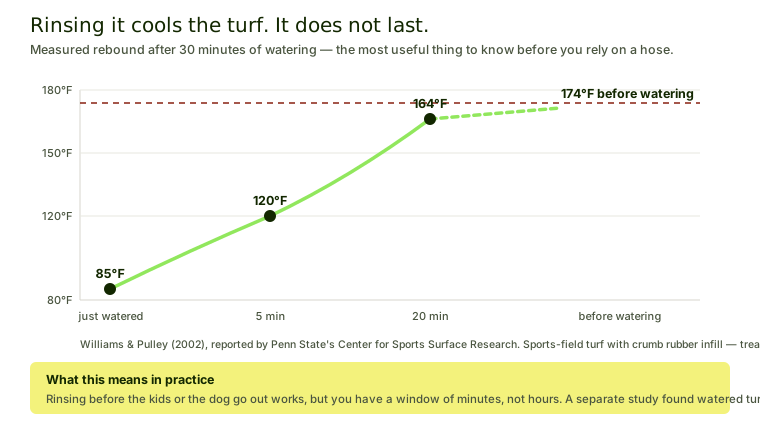
After 30 minutes of watering, surface temperature dropped from 174°F to 85°F — then climbed back to 120°F within five minutes and 164°F within twenty. Rinsing buys minutes, not hours.
Temperature climbed back to 120°F within five minutes and 164°F within twenty minutes of the water stopping. A separate study found watered turf stayed only about 10°F cooler than unwatered turf for roughly three hours — real, but modest, and nothing like an all-afternoon fix.
What doesn’t work, tested and confirmed: calcined clay infill showed no measurable effect, watering and then covering the turf with a tarp showed no effect, and painting crumb rubber white produced only a very minor change. If you’ve seen any of these suggested as a fix, the research doesn’t support it.
The practical version of all this: a hose is a legitimate tool for the specific window when someone’s about to use the yard — right before the kids come out, right before the dog goes out — not a way to keep a lawn cool all afternoon. Timing the rinse to the moment you need it matters more than how much water you use.
So is it a dealbreaker?
That depends on how the yard actually gets used, not on the number itself.
Turf tends to work well for: low-traffic areas that mostly get looked at rather than walked on, shaded yards or partially shaded yards, front yards, and homeowners whose main goal is simply to stop watering.
Worth thinking hard about: a large, unshaded dog run where the dog is out there at 2pm in July, or a barefoot play area with no shade plan at all. BYU’s own operational guideline — used for real athletic fields — is to avoid use above 120°F surface temperature. That’s a useful, concrete line to hold your own yard against: if the surface would clearly be well past that in the afternoon sun with no shade in sight, plan around it rather than around the marketing.
None of this makes turf wrong for a given yard. It makes “it depends on your yard” the honest answer instead of a dodge.
A good installer will talk through shade, infill and placement before quoting. Get a quote from a licensed Arizona installer.
Common questions
Is the 200°F figure real?
Yes — 200°F is a real, published measurement, but it’s from sports-field turf with black crumb rubber infill, not a residential backyard. That’s the hottest-running combination in the research. A typical residential installation using sand or zeolite infill runs cooler, though no equivalent published figure exists to put an exact number on it.
Is artificial turf hotter than concrete or asphalt?
The City of Chandler’s own comparison puts turf surface temperatures in the same range as asphalt pavement. It’s a reasonable mental anchor: think of turf on a summer afternoon the way you’d think about a paved driveway, not the way you’d think about a lawn.
Does a cooling infill or “cooling technology” actually work?
Some products claim a cooling effect, and the closest independently measured variable in the research — infill material — does show a real difference, on the order of 20°F between the hottest and coolest options tested. That’s meaningfully different from turf that stays comfortable underfoot on a 110°F day. Ask a specific, sourced question about any cooling claim rather than taking the marketing at face value.
Will turf hurt my dog’s paws?
Untreated, hot turf can be uncomfortable or worse for bare paws and bare feet in peak summer sun, the same way asphalt or a metal slide can be. Shade, timing (mornings and evenings instead of midday), and a quick rinse before use are the practical mitigations covered above.
Who we are. Arizona Turf Company is a marketing website operated by Wilder West Assets, LLC. We are not a contractor. We do not install artificial turf and we do not hold an Arizona Registrar of Contractors license. Installation work is performed by independent, licensed Arizona contractors. We are compensated by the contractors we work with.
Verify before you hire. Confirm any contractor’s license status directly with the Arizona Registrar of Contractors before signing a contract or paying a deposit.