
What a proper artificial turf installation includes step by step — and the shortcuts that cause most of the complaints you’ll read online.
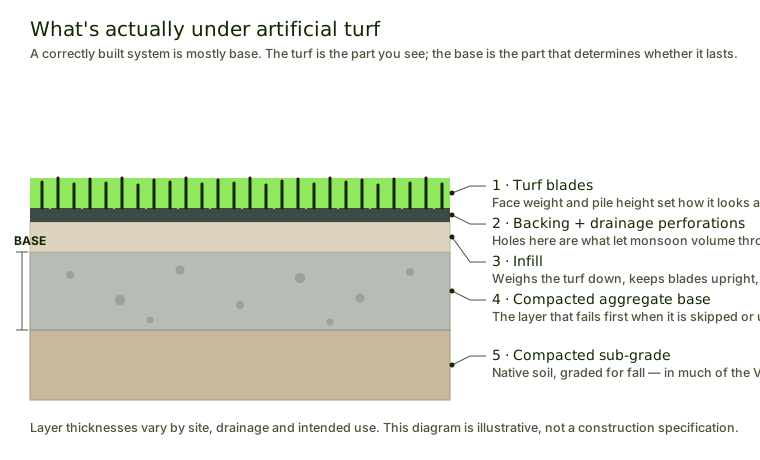
Most artificial turf problems people complain about later — lumps, drainage that never works, seams that show, grass that looks great for a year and then sags — trace back to one thing: a step in the installation process got skipped or rushed. The turf product itself is rarely the problem. Here’s what a correct installation actually involves, so you know what you’re paying for and what to ask about before work starts.
Two parts of the yard get different treatment, since they call for a different turf product and base build rather than a smaller version of the process below: pet-friendly turf depends heavily on drainage and infill choice, and a backyard putting green uses its own turf product and base construction entirely.
Removing what’s there now
Installation starts with taking out the existing surface — grass, weeds, root systems, and any old irrigation heads or sprinkler lines in the footprint. This has to come out completely; leftover organic material underneath turf will eventually decompose, settle unevenly, and create low spots or odor. This step also usually includes hauling the removed material off-site.
Grading and base preparation
This is the step that determines whether the lawn drains properly for as long as it’s down, and it’s also the easiest step to shortcut without a homeowner noticing until the first heavy rain. The area gets graded to the correct slope for water runoff, then a compacted base layer — typically a road-base or decomposed granite material — goes down and gets compacted in stages, not all at once. A rushed or thin base is the single most common cause of turf that develops soft spots, uneven settling, or standing water after Phoenix’s monsoon storms.
Weed barrier
A geotextile fabric layer goes down over the compacted base to block weed growth from underneath. This isn’t the same thing as a plastic sheet — a proper weed barrier fabric allows water through while blocking root growth, which matters for drainage.
Laying and seaming the turf
The turf itself gets rolled out, oriented so the grain (the direction fibers lean) runs the same way across the whole area — mismatched grain direction is one of the more common visible mistakes and shows up as a subtle color or texture seam even when the physical seam is done well. Where two pieces meet, they’re joined with seaming tape and adhesive (or sometimes stitched), and a clean seam should be difficult to find once infill is worked in.
Securing the edges
Perimeter edges get anchored — typically with turf staples or nails into the base, or against a hard edge like a paver border or bender board. Edges that aren’t properly secured are what causes turf to lift, curl, or shift at the borders over time, especially along high-traffic paths.
Infill application
Infill — sand, coated sand, zeolite, or another material depending on the product and household needs — gets spread and worked down into the fibers with a power broom or drop spreader. This step affects appearance, drainage, odor control, and surface heat. (More detail on infill choice is in our infill types guide.)
Final grooming and inspection
A final power-brooming stands the fibers back up after infill application and gives the lawn its finished look. A careful installer walks the finished area checking seams, edges, and drainage before calling the job done — this is worth asking about directly if you’re comparing quotes.
What goes wrong when a step gets skipped
Most turf complaints are recognizable, and most of them point back to a specific shortcut. Knowing what each failure looks like is useful both for judging a finished job and for describing a problem accurately if one shows up later.
Ripples and wrinkles across the surface usually mean the turf wasn’t stretched and anchored properly during installation, or that the base beneath it has shifted. Soft or sunken spots underfoot almost always trace back to base compaction — either too little of it, or organic material left in the ground that has since broken down. Water standing on the surface after a storm points at grading or at a base that doesn’t drain, and it tends to appear in the same spot every time. Seams you can find from standing height come from mismatched grain direction, poor seam preparation, or adhesive that didn’t hold. Edges lifting or curling mean the perimeter wasn’t anchored well enough for the traffic it gets. Thin, flattened patches where the infill has migrated or washed out are usually a maintenance issue rather than an installation one, though under-filling at installation makes it happen sooner.
The distinction that matters most is between a surface problem and a base problem. A seam, an edge, or thin infill is a surface issue. Sinking, persistent standing water, and widespread rippling usually are not — they point underneath the turf, which is a different and more involved kind of repair. If you’re seeing the second category, it’s worth describing it that way when you call someone, because it changes what the job actually is.
Permits, HOA rules, and your existing irrigation
Three practical things that catch people between deciding and installing.
Permits vary by municipality and by how much you’re changing. A straightforward ground-level turf installation often doesn’t require one, but altering drainage, adding hardscape, or changing grade can bring a project into permit territory. Check with your city or town, or ask whoever quotes the work — local requirements are something an established local contractor should already know.
HOA rules apply if you’re in a planned community. Under A.R.S. § 33-1819, a community that allows natural grass generally can’t prohibit artificial turf once it’s past the developer-control period — but it can still set reasonable rules on installation, appearance, location, coverage and product quality, and it can prohibit turf outright in areas the association itself maintains or irrigates. The front yard and backyard pages go into how that plays out differently depending on which part of the property you’re converting.
Your irrigation system needs a decision, and it’s the one most often left until the crew is already on site. Sprinkler heads and lines inside the turf footprint get capped or removed. If you’re keeping planting beds or trees, their watering has to be handled separately — and this is the detail that causes real damage when it’s missed: established trees in a lawn have usually been drinking from the lawn sprinklers. Take that water away without giving the tree its own emitters at the canopy dripline, and the tree will show it within a season or two. Raise it before work starts, not after.
When to install, and why timing matters more here
Turf can be installed year-round in the Phoenix area — there’s no season where it becomes impossible — but the extremes cut both ways and they’re worth understanding before you schedule.
Synthetic turf expands and contracts with temperature. Material delivered and laid in peak summer heat is at its most expanded; the same turf in January is not. Installers generally account for this by letting rolls acclimate on site before cutting and seaming, and by adjusting how tightly the material is stretched and anchored. It’s a normal part of the craft rather than a problem, but it’s a fair thing to ask about — particularly if your job is being quoted for the hottest or coldest part of the year.
Demand also moves with the calendar. Interest in turf tends to build through the autumn and into spring, when people are outside looking at their yards and thinking about the summer ahead, which means scheduling can be tighter then than it is in midsummer. If your timeline is flexible, that’s worth knowing when you’re planning.
Getting your yard ready for the crew
A few practical things, none complicated, all easier to sort out before the day than during it.
Access matters more than people expect. Base material, turf rolls and infill are heavy and bulky, and how they reach the work area drives the labor in the quote. A backyard reachable only through a narrow side gate is a genuinely different job from one with a wide gate or open access. Point out the actual route in advance rather than letting it be discovered.
Clear the space and plan for staging. Furniture, planters, play equipment and anything else in the footprint needs to move, and the crew will need somewhere to stage material — often a driveway. Working out where in advance avoids a conversation at seven in the morning.
Plan for pets and for dust. Demolition and base work are dusty and noisy, and a yard mid-installation isn’t somewhere a dog should be. If the space is your pet’s main outdoor area, have a plan for the duration.
Decide about irrigation and trees before work starts, as above. It’s much easier to re-plumb a bed or add emitters at a tree while the yard is already open than to come back to it.
What drives cost from one job to the next
Every installation is priced around the same handful of variables: the turf product itself, how much demolition and haul-off is needed, site access (a fenced backyard reachable only by wheelbarrow costs more labor than an open front yard), how much base prep and grading the site needs, drainage requirements, infill choice, edging and border work, whether pets will use the space, and general site conditions like existing hardscape or irregular shapes. A quote that doesn’t walk through these specifics for your yard is worth questioning. For real Phoenix-market price ranges and what typically moves them up or down, see the cost guide.
What to ask before you sign anything
- What does the base prep involve, and how many inches of base material and compaction passes?
- What weed barrier and seaming method are you using?
- How is drainage handled for this specific yard?
- What infill is included, and does that change with pets in the household?
- Is haul-off of the old material included in this price?
A contractor who answers these plainly, without hedging, is describing a real process — not reciting a sales script.
What a written quote should actually specify
A quote that says “supply and install artificial turf” and gives a number tells you nothing you can compare, hold anyone to, or check against the finished job. Before you sign, the document should put the following in writing:
- Square footage, and how it was measured. Turf measurements often run larger than the plain area of the space, to account for curves, cuts and grain direction. That can be legitimate — but it should be stated rather than buried.
- The turf product by manufacturer and product line, with its face weight and pile height, not just “premium turf.”
- The base — what material, and to what compacted depth.
- The infill — which type, and how much.
- The edging method and how the perimeter is secured.
- How drainage is being handled for this particular yard.
- Whether haul-off of the removed material is included or billed separately.
- Who caps or modifies the irrigation, and whether trees and beds are being re-plumbed.
It’s also worth asking what warranty applies — to the turf product itself and, separately, to the workmanship — and getting the answer in writing rather than in conversation. The two are often different lengths and come from different places, and that’s a normal thing to ask about rather than an awkward one.
Finally, verify the contractor’s license yourself before work starts. Arizona’s ROC license lookup is public and takes about a minute at roc.az.gov.
Common questions
How long does an installation take?
It depends heavily on yard size, how much demolition is needed, and site access — a contractor walking your specific property can give you a real timeline; broad ranges you’ll see quoted online vary too much by job to be useful here.
Can turf be installed over concrete?
Sometimes, with a different base approach than a dirt yard requires. This is a site-specific question for whoever quotes your project.
Does installation quality actually vary that much between contractors?
Yes — the material differences between turf products are often smaller than the differences in how carefully the base, drainage, and seams were done. This is why the process itself, not just the product, is worth understanding before you compare quotes.
Get a quote from a licensed Arizona installer and ask the questions above directly.
Get a free turf installation quote
Tell us the area you want covered and we’ll connect you with a licensed Arizona installer for a no-obligation estimate.
Request a quote How this works
Or callRequest an installation quote
Free, no obligation. Your details go to one licensed Arizona installer — we don’t sell your information to a list of contractors.
Who we are. Arizona Turf Company is a marketing website operated by Wilder West Assets, LLC. We are not a contractor. We do not install artificial turf and we do not hold an Arizona Registrar of Contractors license. Installation work is performed by independent, licensed Arizona contractors. We are compensated by the contractors we work with.
Verify before you hire. Confirm any contractor’s license status directly with the Arizona Registrar of Contractors before signing a contract or paying a deposit.
Arizona Turf Company is operated by Wilder West Assets, LLC — a marketing company, not a contractor. Installation is performed by independent licensed Arizona contractors.